




Blog
How to choose the right color temperature? Kelvin and light color simply explained!
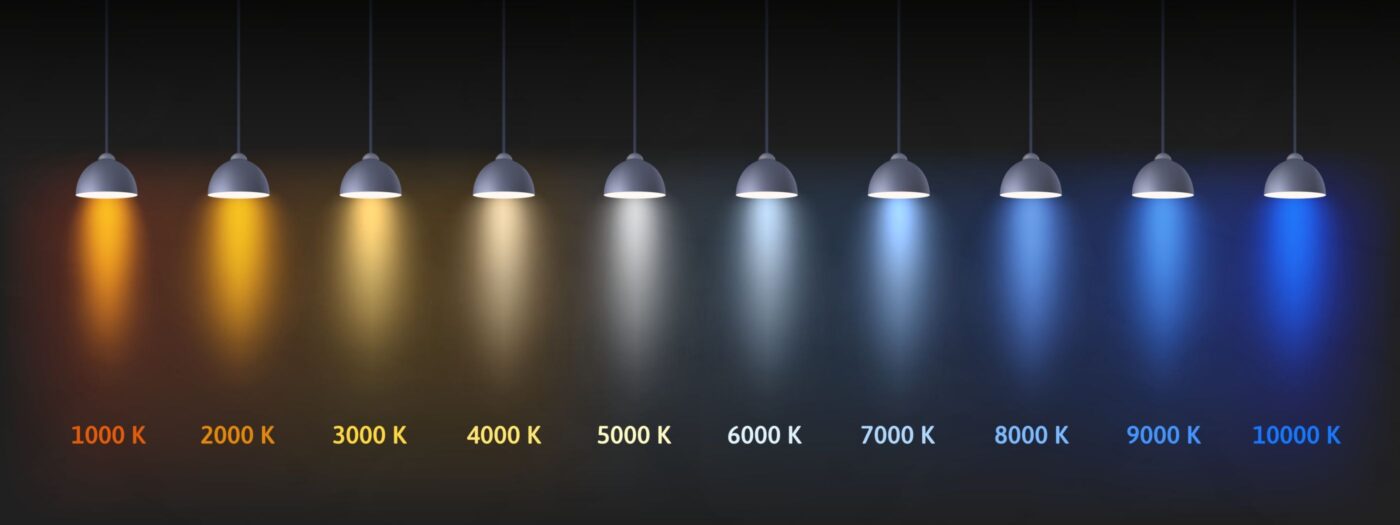
Proper color temperature is key to ideal illumination of rooms and creating a pleasant atmosphere.
But what does color temperature really mean? How do terms like Kelvin and the color of light differ, and which color of light suits a particular room? In addition: How does the interaction of light color and color rendering (CRI) affect color perception? In this blog post, you will learn everything you need to know about colour temperature – from basics to practical application tips.
What is the color temperature?

The following applies:
- Warm white (2700-3300 K): An intimate and relaxing atmosphere.
- Neutral white (3300-5000 K): Clean and functional, ideal for workspaces.
- Living room white (from 5300 K): Cold light that promotes concentration.
.
How does color rendering index (CRI) affect color perception?
Colour rendering is determined solely by the colour rendering index (CRI). While color temperature indicates whether light looks warm or cold, CRI (0-100) describes how accurately colors reproduce. The overall CRI (Ra) is calculated from the first eight test colours (R1-R8), which only cover moderately saturated, pastel-like colours. This is a weakness, as important color ranges, such as saturated reds or skin tones, are not taken into account. Unique values such as R9, which describe saturated red tones, therefore provide additional information on actual color rendering. Since R9 is not included in the calculation of the general CRI, two light sources with the same CRI can reproduce different red tones. Low R9 may make skin tones look dull.
A useful comparison: The effect of color rendering is comparable to that of a television with incorrectly adjusted colors. In light with low color rendering, the colors look unnatural or distorted. This is not about color saturation in the technical sense, but about how realistic colors are under a particular light source.
Bottom line: a 3000 Kelvin light source may seem more pleasant than a 2700 Kelvin light source – if the CRI is significantly higher. This shows how important colour rendering is for the perceived quality of light, regardless of the colour of the light.
- High CRI (> 90) : Colors are bright and natural
- Low CRI (< 80) : The colors look pale, lacking in intensity and unnatural, especially reds.
The Profit Tip: Typically, lamps with a CRI value of 90 or higher we recommend that you choose – this always leads to a more natural perception of colour. If possible, avoid CRI 80 light sources. A good example of this is the bathroom: even with 2,500 kelvins, the light may seem unnatural if the CRI is only 80 – the result is that you put on ‘bad’ make-up and look completely different in daylight than you would expect. High-quality luminaires with 95-99 CRIs are therefore more expensive, but they visibly offer better light quality than cheap products with low CRIs.
Why is CRI so important?
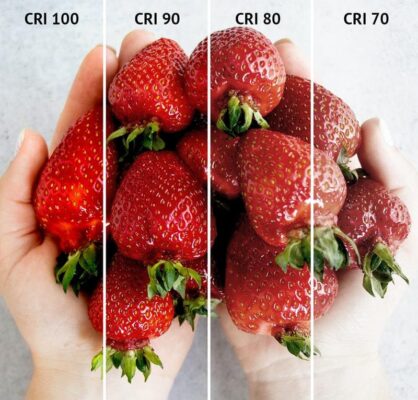
A high CRI (> 90) is essential for natural colour reproduction – especially in the kitchen, bathroom or for creative activities. Even light with a low color temperature (e.g. 2700 K) may seem unnatural in a bad CRI, as the colors appear faint or distorted. Sunlight with a CRI of 100 is considered the benchmark. When light is perceived as unpleasant, it is often due to poor colour reproduction – not to the colour temperature itself.
Color temperature vs. brightness: the difference
The terms color temperature and brightness are often confused with each other, even though they describe different properties:
Colour temperature (in kelvin) : Indicates whether the light source looks warm or cold.
Luminous flux (in lumen) : It is often referred to as the ‘quantity of light’ and describes the total light output of the lamp.
Brightness (in cd/m² ): It describes the so-called luminance – that is, the light that comes from the illuminated or illuminated surface into the eye. This is the only photometric amount that we actually see. ‘cd’ means candela, which is a unit of luminous intensity. Thus, cd/m² refers to the luminous intensity per square metre of surface.
These values are independent of each other, but together they affect the lighting effect. A 2700 K (warm white) lamp can look very bright if it provides enough luminous flux and meets reflective, bright surfaces that generate high brightness. In contrast, a 6500K (daytime white) lamp may look less bright due to brightness control or dark surfaces.
Illumination (in lux, lx) is also key: describes how much light hits the surface – not to be confused with the Lumen L ,, which indicates the total amount of light emitted. However, illumination alone does not determine the visible brightness: high lux can also result in low brightness on a dark surface – and thus low visible brightness.
For information: At least 500 lux in offices and computer workstations. Street lights typically provide 5-20 lux on sidewalks.
This means that a lamp with a high lumen value can generate very different lux and brightness values depending on distance, light distribution and surface reflection.
High illumination (> 300 lx) : Enhances the activation effect of cold light.
Low illumination (< 300 lx) : It provides a relaxing effect even in cold light.
Background : Color temperature describes the color of the light source and is based on physical principles (Plank radiator). Luminous flux describes the amount of light emitted. However, the perceived brightness is due to the luminance, i.e. the light reaching the eye from the illuminated surfaces. The impression of brightness therefore depends not only on the light itself, but also strongly on the reflective materials in the room.
Which light color suits your room?
The choice of color of light should be adapted to the function and use of the room, as well as the amount of natural light and illumination available. During the day, in rooms rich in natural light, a cooler light complementing the color of daylight is recommended. In the evening, on the other hand, warm white light is recommended to create a calm atmosphere – whether there are windows in the room or not. In this case, it is ideal to use a luminaire with dimming technology, where the color temperature automatically becomes warmer when controlling.
Another important factor is whether there is any connection with daylight. In rooms without daylight, warm white light is recommended, since neutral white or daylight white light here often looks unnatural.
In addition, the illumination value (lux) also plays a role: The higher it is, the more neutral or cooler the light can be. For high illumination levels, e.g. in offices of 500-1000 lux, at least 4000 K is recommended to achieve an activating light effect.
Important: The choice of color of light is determined not only by the type of room, but above all by the specific situation of use. For example, working in the living room can benefit from a cooler, invigorating light – while a tea on the counter in the evening looks more cosy in warm light.
Benefit tip: Tunable white light is suitable for rooms where the brightness varies. This function allows you to adjust the colour temperature flexibly, depending on the time of day, mood or activity. For example, the daytime evening turns into a cozy room of 2700 K, and during the daytime into a work corner illuminated with neutral white light.
Recommended color temperatures for different rooms:
Space: Living room
- Recommended color temperature: 2700-3000 K
- Impact: Comfortable, relaxing
- Example of lighting: Floor or ceiling lamps with dimming control
Space: Kitchen
- Recommended color temperature: 3300-4000 K
- Impact: Clear view, functional
- Example of lighting: Cabinet luminaires, pendant luminaires
Space: Bathroom
- Recommended color temperature: 3,300-5,300 K
- Impact: Accurate, colour-like
- Example of lighting: Mirror lamps, recessed lamps
Space: Study room/office
- Recommended color temperature: 4000 K
- Impact: Promotes concentration Non-reflective
- Example of lighting: table lamps
Space: Corridor/Entrance
- Recommended color temperature: 2700 K
- Impact: Invitation, cozy
- Example of lighting: Wall lamps, ceiling spotlights
Space: Evening (general)
- Recommended color temperature: 2700 K
- Impact: Sedative, promotes melatonin production
- Example of lighting: Warm dipped-beam luminaires with indirect light
The choice of the color of light also depends on regional preferences: In warm climates, cold white light is often preferable, while in colder regions, warm white light seems more pleasant.
How do light colors affect our well-being?
Light affects not only our visual perception, but also our emotional well-being. The right combination of color temperature and illumination can have a calming or activating effect.
- Warm light (2700-3000 K): It feels pleasant, has a calming effect and creates a calm atmosphere. Ideal for evenings, bedrooms and living rooms.
- Cold light (> 5300 K): It has a clear effect, promotes alertness and wakefulness. Especially suitable for workplaces and fitness rooms. Neutral white (3300-5300 K): It provides a balanced effect, supports focused vision and is suitable for kitchens and offices.
Illumination (in Lux) plays a crucial role here:
- Low illumination (< 300 lx): When combined with warm light, it creates a pleasant effect.
- High illumination (> 300 lx): Enhance the activating effect – especially in the case of cold light.
It is important to understand that cold light alone does not have an activating effect – the decisive factor is the illumination, especially the vertical illumination on the eye, generated by the upper field of vision, such as the sky or corresponding artificial illumination. This is the only way to influence people's biological rhythms. The colour of light plays a key role in emotional perception – for example, whether a room feels cozy, functional or invigorating.
Profit tip: Dimmable white luminaires and lamps
Lighting needs vary depending on the time of day, activity or mood. Modern lighting technologies, such as dimmable luminaires and tunable white, allow you to adapt the brightness and color temperature to your individual needs in a flexible way. While dimmable luminaires continuously control the luminous intensity, the color temperature remains unchanged. The heating function, on the other hand, ensures that the brightness control not only reduces the brightness, but also makes the colour of the light warmer – ideal for creating a cozy atmosphere.
The Tunable White (Tanable White) The term describes the possibility of adjusting the colour of light independently of the amount of light or the level of brightness control – e.g. from warm white to daytime white without automatically changing the amount of light. Although many luminaires with tunable white have separate brightness control functions, tunable white itself is not a brightness control function. The color temperature and the amount of light can usually be controlled separately from each other.
Some luminaires combine these technologies, allowing for comprehensive lighting control at all times of the day and in the mood. These innovative systems not only increase housing comfort, but also promote well-being and productivity.
So let's keep in mind:
1. A kelvin (K) the unit of measurement of the colour or colour temperature of the light.
2.Colour or colour temperature of light visual impression of light, which is due to a mixture of red and blue components in the light.
3, The color or color temperature of the light measured in Kelvin (K) describes whether the light looks hot or cold .
- Warm white light (up to 3000 K) It creates a cozy atmosphere and is especially suitable for living rooms and bedrooms.
- Neutral white light (3300-5000 K) clean and functional, ideal for kitchens, bathrooms or study rooms.
- Daytime white light (from 5300 K) promotes concentration and is suitable for learning or fitness areas.
4, CRI value (colour rendering index) indicates how realistic the colours of objects are under a particular light source. Values greater than 90 are ideal for displaying highly realistic colors.
5, One of the essential quality criteria of the light source is the correct choice of color temperature and very good color rendering (CRI, R9).
6. Modern lighting technologies:
- Dimmable luminaires: The amount of light emitted by the luminaire may be controlled.
- Brightness heating: When the brightness is reduced, the light becomes warmer, as we are accustomed to with incandescent lamps.
- Adjustable white: The brightness and color temperature of the luminaire can be adjusted independently of each other.
7. Colour and color temperature of light has a significant impact on the mood and well-being of the room.
8. Choose the right light source as regards both the colour and the colour temperature of the light: Check the specifications of the luminaire or light source on the packaging or on the technical data sheet.


